Free calculator · no email needed
Debt payoff calculator
snowball vs avalanche.
Enter your debts and how much extra you can pay each month. See your debt-free date and the interest each method costs, side by side.
Short answer: the avalanche method (highest interest rate first) costs the least interest. The snowball method (smallest balance first) clears your first debt sooner, which keeps many people going. Both beat paying only the minimums by a wide margin.
Keep the plan in a spreadsheet
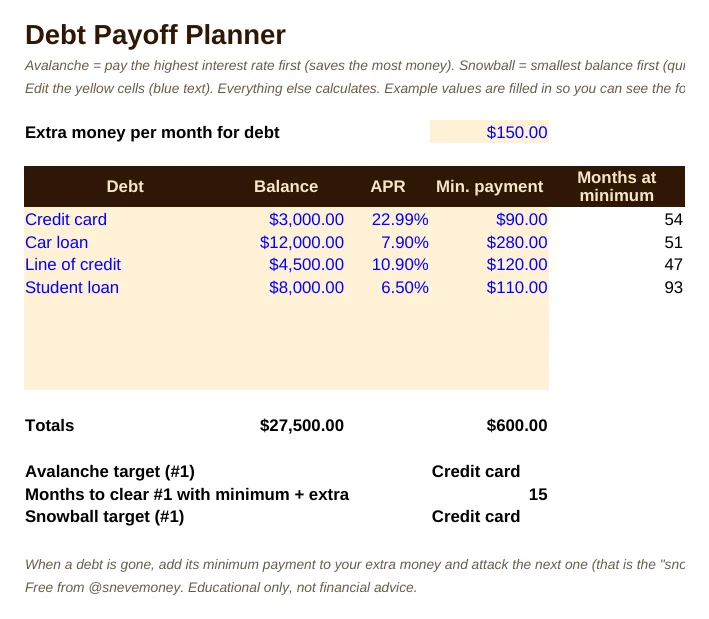
Get the free Debt Payoff Planner (Excel or Google Sheets): your debts, your order, month by month.
Free. Plus one money email a week. Unsubscribe in one click.
How the two methods work
Avalanche: pay the minimum on everything, and put every extra dollar on the debt with the highest interest rate. When it is gone, roll that payment into the next-highest rate. This costs the least interest.
Snowball: same idea, but target the smallest balance first. You clear a debt sooner, and that early win keeps many people motivated.
The part that matters most is the extra. Even $50 to $150 a month on top of the minimums usually cuts years off and saves far more than the choice of method. Try changing the extra amount above.
Before you start
- Stop adding new debt to the cards you are paying off.
- Keep a small emergency fund so a surprise bill doesn't go back on the card.
- Call your card issuer and ask for a lower rate. It doesn't always work, but it costs one phone call.
Questions
What is the difference between snowball and avalanche?
Both pay the minimum on every debt and put all extra money on one target. Snowball targets the smallest balance first; avalanche targets the highest interest rate first. When a debt is gone, its payment rolls into the next one.
Which method should I use?
If the interest difference is small, pick the one you will stick with. If one debt has a much higher rate (for example a credit card near 20–30%), avalanche usually saves real money.
Why does it say "never"?
If a payment does not cover the monthly interest, the balance grows. Pay more than the interest to make progress, or look at a lower-rate option.
Does it include fees or rate changes?
No. It assumes fixed rates, fixed payments and no new spending. Treat the result as an estimate.
Is this financial advice?
No. It is an educational estimate. For help with debt in Canada, a non-profit credit counselling agency can review your situation for free.
Interest is calculated monthly (rate ÷ 12) on each balance. Minimum payments stay fixed; freed-up minimums roll into the next target.
Want all of it in one file? Money Toolkit Pro links 10 tools together, CA$19. The free tools stay free.
More free tools: TFSA vs RRSP vs FHSA calculator · Free budget template · all calculators · money quiz